
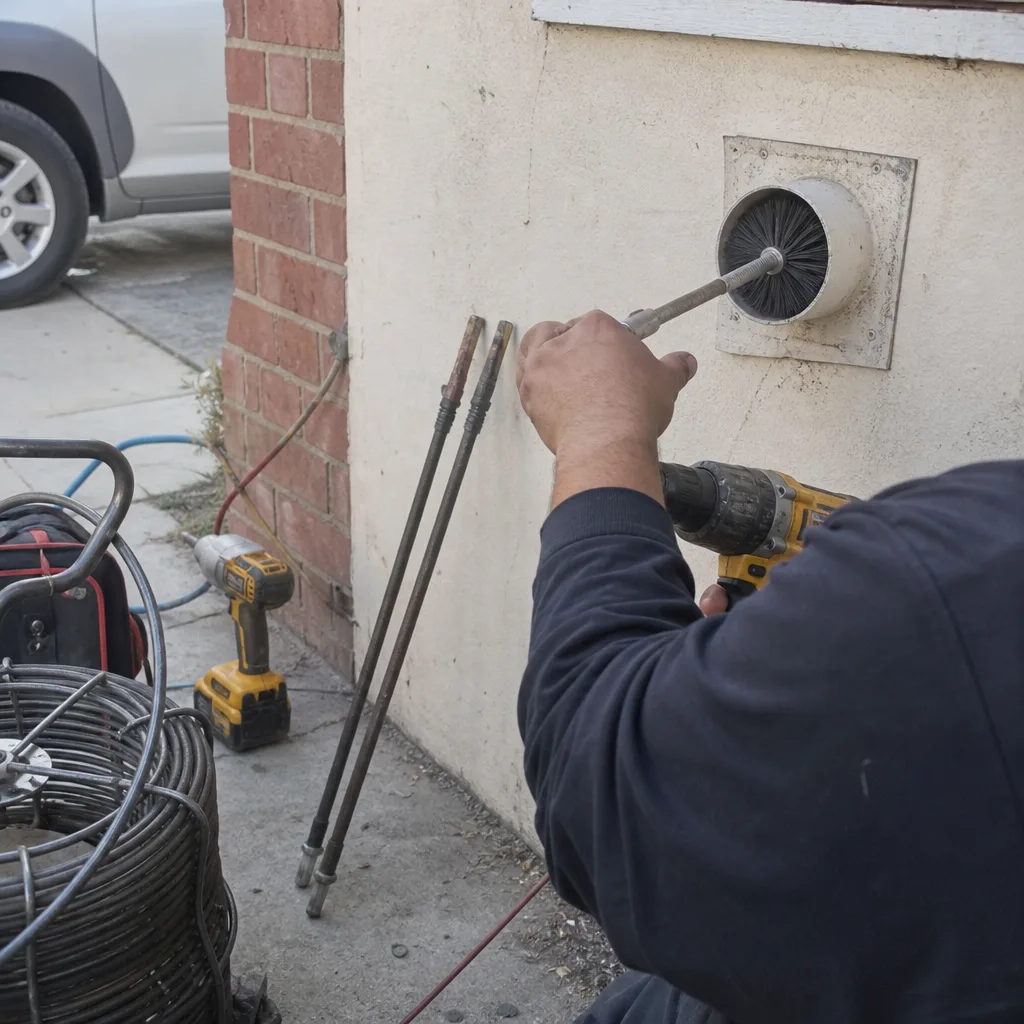
Last updated November 2, 2026
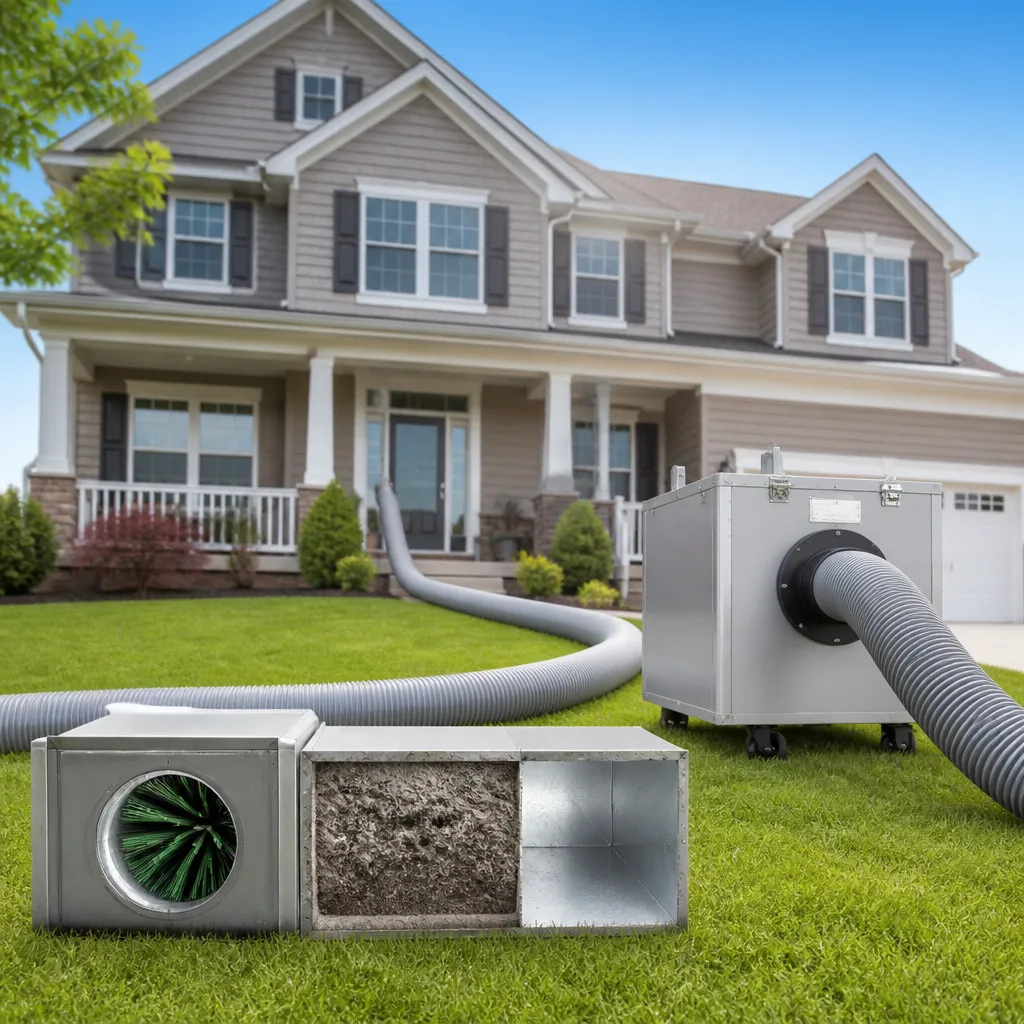 Whole-home duct cleaning
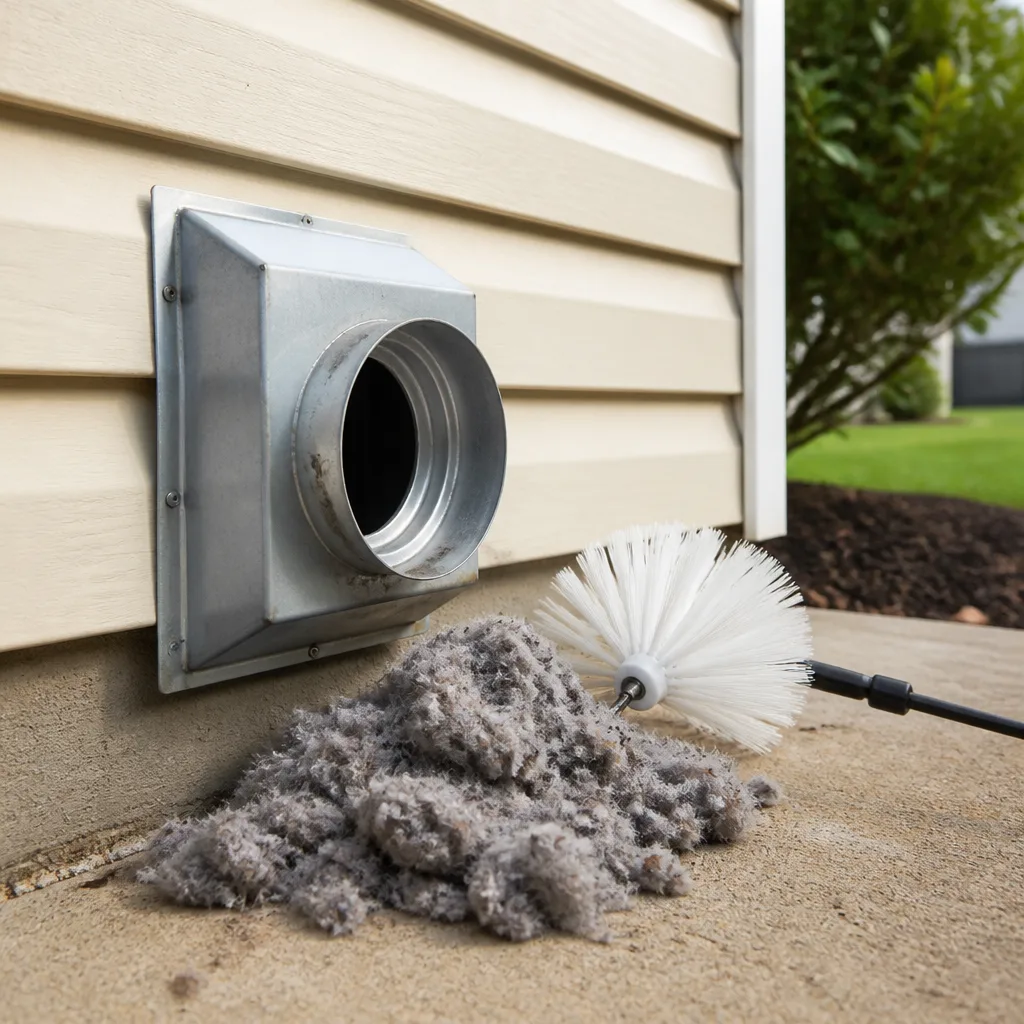 Dryer vent cleaning
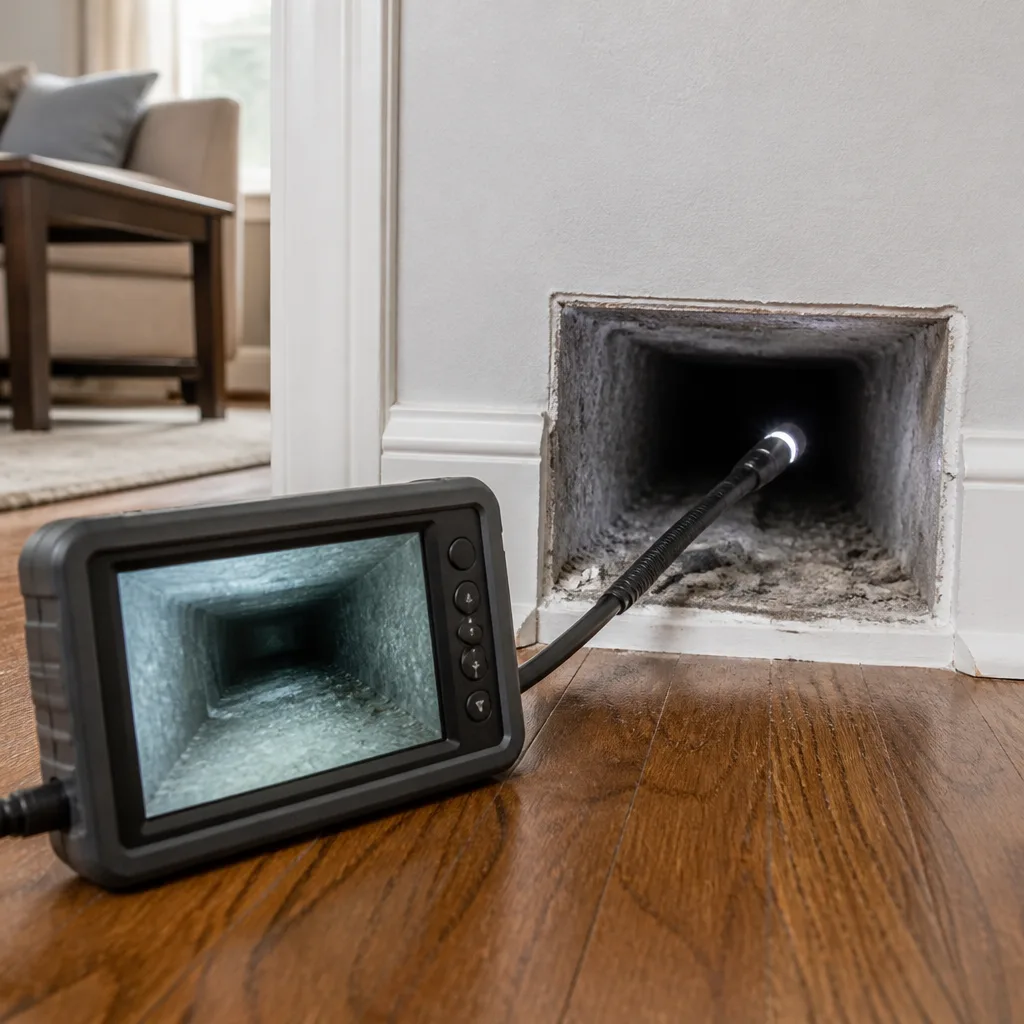 Camera inspection
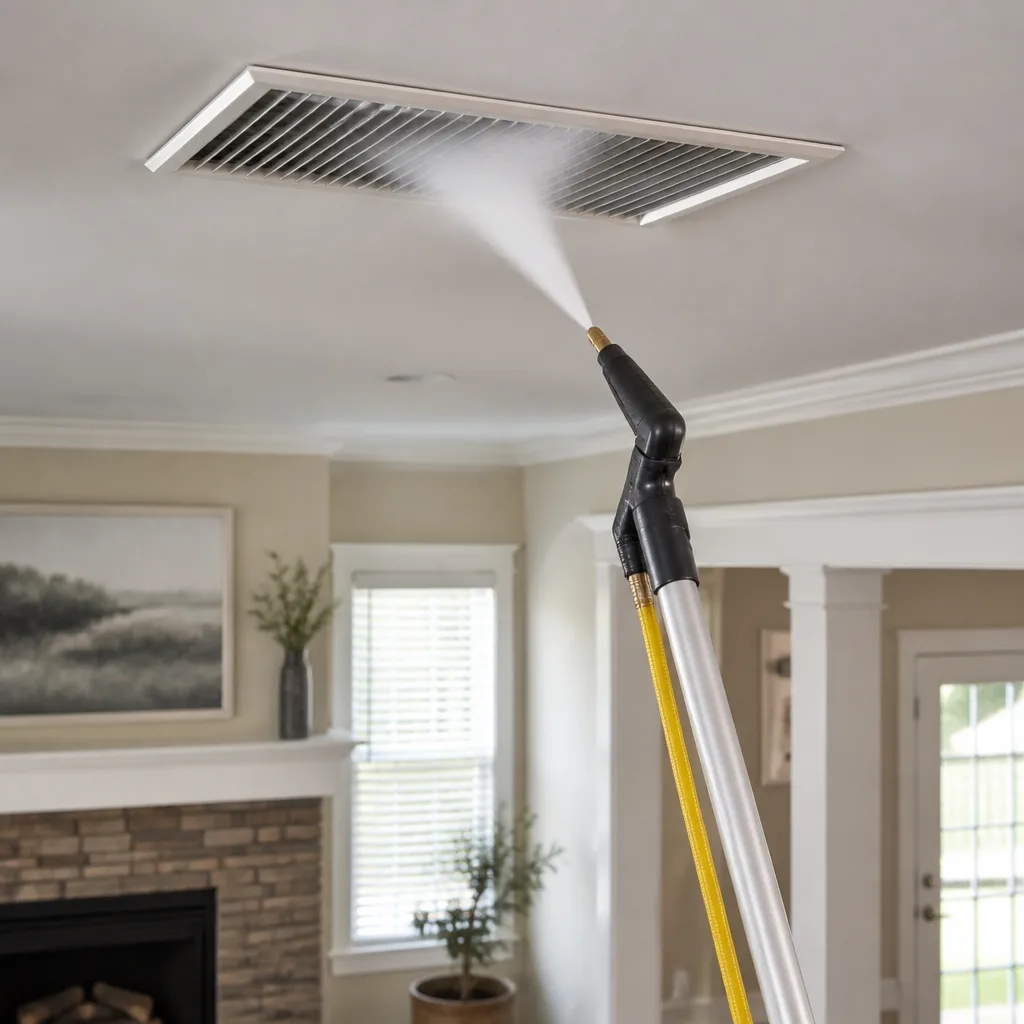 Sanitizing & deodorizing
Whole-system duct and dryer vent check with before-and-after photos - you see exactly what came out of your vents
That "$99 whole-house special" is a bait ad - the real number appears once they are in your hallway, or the "clean" is a shop-vac at the register. We photograph the inside of your ducts before and after instead.
Air Duct Cleaning Emergency Preparedness Guide for Monterey Park Homes
Monterey Park sits on a geological and geographic fault line of air quality risk. To our east, the San Gabriel Mountains carry wildfire smoke into the San Gabriel Valley on prevailing winds. Below us, the Whittier Narrows fault system shifts ground that homes are bolted to. When either event occurs, the ductwork running through your walls and attic becomes a reservoir for whatever the air carried in. Most homeowners in Monterey Park have no written protocol for what happens inside their HVAC system after a wildfire, a 4.0-magnitude tremor, or a kitchen renovation that coats every return register in drywall dust. This guide and our Air Duct Cleaning Maintenance Checklist for Monterey Park Homeowners close that gap. It defines exactly when to seal your system, when to inspect it, when to clean it, and when to repair it. If you own a home in Monterey Park, the information here is specific to the risks we actually face, not a generic list of air quality tips.
Quick Answer
After a wildfire smoke event, a seismic tremor above roughly magnitude 4.0, or any renovation that produced visible dust, you should first assess whether particulate entered your duct system, then decide between sealing, cleaning, or repairing based on what you find. In most Monterey Park homes, a post-emergency inspection with a camera scope and professional Air Duct Cleaning (not a shop vacuum) is the difference between a one-time event and months of re-suspended contaminants every time the blower runs.
Styles & brands we work with
- Whole-home duct cleaning
- Dryer vent cleaning
- Camera inspection
- Sanitizing & deodorizing
Table of Contents
- Wildfire Smoke Protocol: When to Seal, When to Clean
- Earthquake Response: Duct Inspection After Seismic Events
- Post-Renovation Air Quality Recovery Sequence
- Emergency HVAC Shutdown Procedures for Monterey Park Homes
- Building a Post-Emergency Service Record
- Why Equipment Standards Matter After an Emergency
- Common Mistakes to Avoid
- When to Call a Professional
- Frequently Asked Questions
Wildfire Smoke Protocol: When to Seal, When to Clean
After a regional wildfire smoke event, the fine particulate that infiltrated your Monterey Park home through return ducts doesn’t disappear when the air clears. It settles into duct surfaces and re-suspends every time the system runs, sometimes for months afterward. The decision to clean is not based on whether you smelled smoke. It’s based on what actually entered the system.
Here is the threshold-based protocol we recommend for Monterey Park homes:
- At AQI 100 to 150 (Unhealthy for Sensitive Groups): Close fresh-air intake dampers if your system has them. Switch the thermostat fan from “Auto” to “On” during active smoke hours only if you have a MERV 13 or higher filter installed. Do not run the system continuously with a standard fiberglass filter; it will not capture smoke particles.
- At AQI 151 to 200 (Unhealthy): Seal the system. Close all exterior doors and windows. Set the thermostat to “Off” or “Fan Off” during peak smoke hours. Run a standalone HEPA air purifier in occupied rooms instead. The HVAC system is not an air purifier unless it was designed with high-efficiency filtration.
- At AQI above 200 (Very Unhealthy to Hazardous): Turn the HVAC system off completely. Tape over return registers is unnecessary if the system is off and the blower is not drawing air. Evacuate if local authorities instruct. Do not attempt to “flush” the system by running it after the event; this re-suspends what settled during the event.
- After the smoke clears (AQI drops below 50 for 48 hours): Remove and inspect the air filter. If it shows gray or brown discoloration, assume duct contamination occurred. Schedule a camera scope inspection of the supply and return duct interior surfaces.
Here is the counterintuitive part: a HEPA filter upgrade alone does not address duct-deposited PM2.5. The filter sits at the return side of the air handler. It captures particles as air moves through it. But particles that already settled onto the duct walls upstream of the filter, inside the return plenum, or inside the supply runs after a smoke event are already past the filter. No filter change removes them. They release back into the airflow stream whenever humidity shifts, when the blower cycled on after sitting idle, or when someone walks across the floor above a flex duct and vibrates it. In our experience with Monterey Park homes after the 2020 Bobcat Fire smoke intrusion and the 2025 regional fire events, the homes that recovered fastest were the ones that sealed early and cleaned once, thoroughly, with equipment designed for particulate removal, rather than running box fans and hoping.
For a full breakdown of what a proper cleaning actually involves, see our Air Duct Cleaning in Monterey Park page. The short version: it’s a negative-air process with agitation, not a vacuum hose waved inside a register.
Earthquake Response: Duct Inspection After Seismic Events
Monterey Park sits within the influence zone of the Whittier Narrows fault, and the 1987 Whittier Narrows earthquake (magnitude 5.9) produced strong shaking across the San Gabriel Valley. Modern building codes require duct systems to be braced and strapped, but the connections between sheet metal sections, flex duct, and register boots are friction-fit materials that can slip or separate under lateral force. A tremor does not need to crack your foundation to dislodge a duct joint inside a wall cavity.
Here is the response threshold we suggest:
- Below magnitude 3.5: No action needed for ductwork specifically. If you hear a new rattle or airflow change, note it and monitor.
- Magnitude 3.5 to 4.5: Do a visual check of accessible registers and visible duct runs in the attic or crawlspace. Look for gaps at register boots, sagging flex duct, or visible separation at taped joints. If you notice reduced airflow from any single register, that’s a red flag.
- Magnitude 4.5 and above: Schedule a camera scope inspection of the full duct system. A displaced joint inside a wall cavity is invisible from the living space and will not show up as a puddle or a crack. It shows up as a room that suddenly takes longer to heat or cool, or a persistent dusty smell that wasn’t there before.
What does a displaced duct joint look like on a camera scope? The interior wall of a properly connected duct run is smooth and continuous. After seismic movement, you’ll see one of three things on screen: a visible gap where the inner liner has pulled back from the metal collar, a step offset where one section shifted laterally relative to the next, or a crushed flex duct where the inner coil was compressed during shaking. Any of these conditions means conditioned air is being pushed into the wall cavity or attic rather than into the room. That drives up your utility bill and pulls insulation fibers or crawlspace air into the supply stream.
If the inspection finds structural displacement, cleaning alone will not fix it. This is exactly the scenario where Air Duct Repair in Monterey Park matters: the duct needs to be reconnected, re-supported, and re-sealed before any cleaning has lasting value. We repair what we find.
Post-Renovation Air Quality Recovery Sequence
Renovations in Monterey Park homes often happen while the HVAC system is still running. Contractors protect floors with plastic sheeting. They rarely seal return registers. Every pass of a drywall sander, every sheet of insulation batt, every cut of MDF trim sends fine particulate into the air. The return side of your HVAC system is actively pulling air in whenever the blower runs. Even if the thermostat is set to “Off,” many modern systems cycle the blower periodically for ventilation.
The sequence for restoring duct cleanliness after construction work is specific. Do it out of order and you’ll re-contaminate the system.
- Seal returns during active work. Cover all return registers with magnetic sheets or plastic secured with painter’s tape. This is the installer’s or homeowner’s job, not the HVAC contractor’s. If this step was skipped, assume contamination.
- Complete all drywall sanding, insulation work, and demolition before any cleaning. Do not schedule a duct cleaning on a Tuesday if the tile crew is cutting on Wednesday. Cleaning before the work is done means the system gets dirty again immediately.
- Replace or deep-clean the air filter after active dust generation ends. A clogged filter during post-renovation operation adds strain to the blower motor and pushes air around the filter rather than through it.
- Clean the duct system after the final sanding pass, not before. This is the single most common mistake we see in Monterey Park renovation projects. Homeowners schedule duct cleaning on the last day of demo, then the finish carpenters come through and generate a second wave of fine dust that settles right back into the supply runs.
- Run the system on “Fan On” for 24 hours after cleaning to push any residual particulates through a fresh filter rather than letting them settle back into the now-clean ductwork.
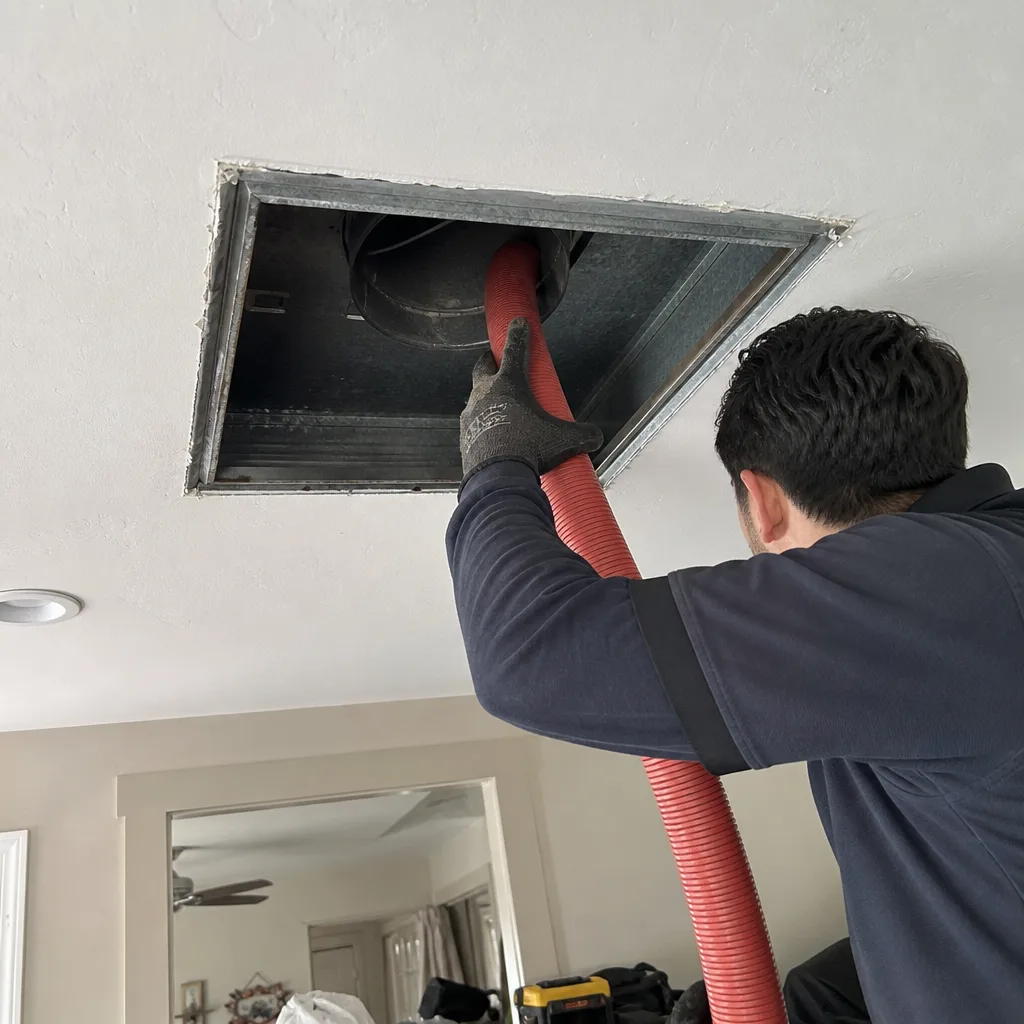
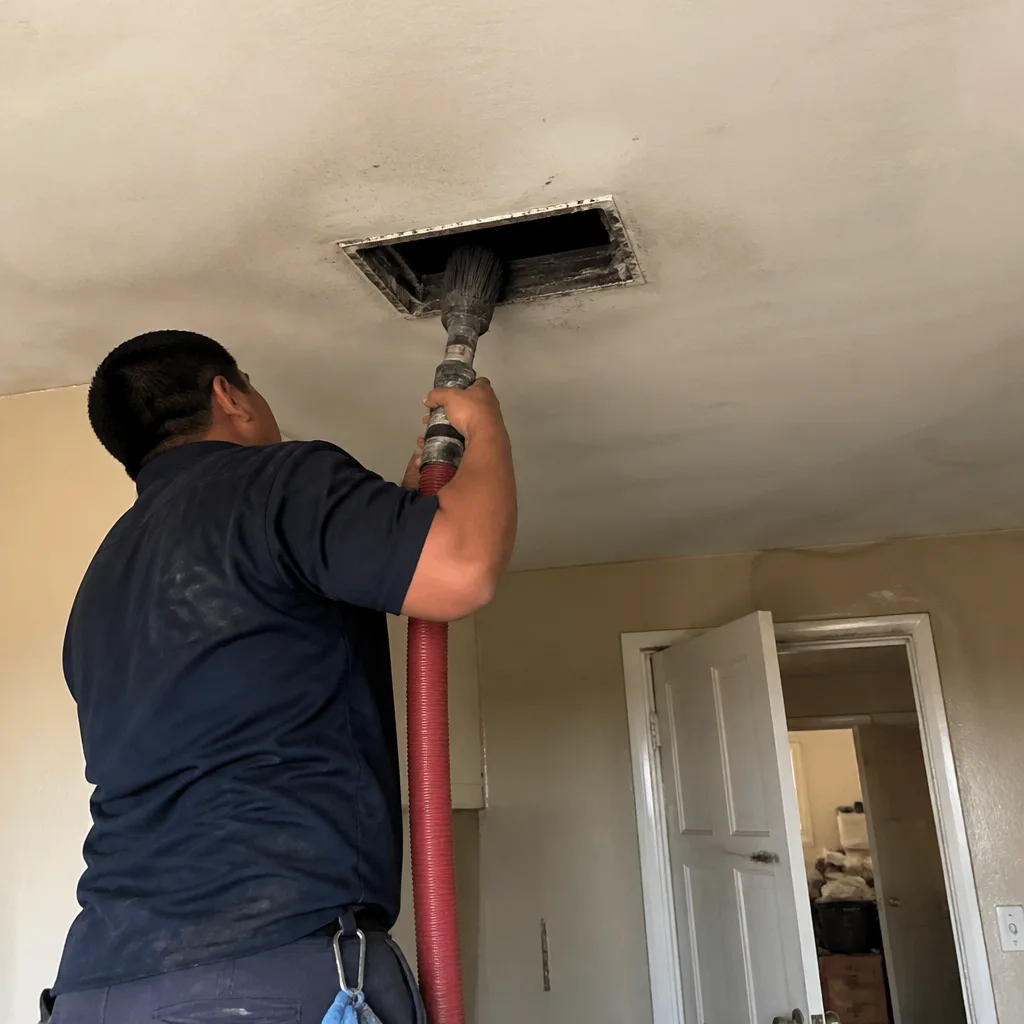
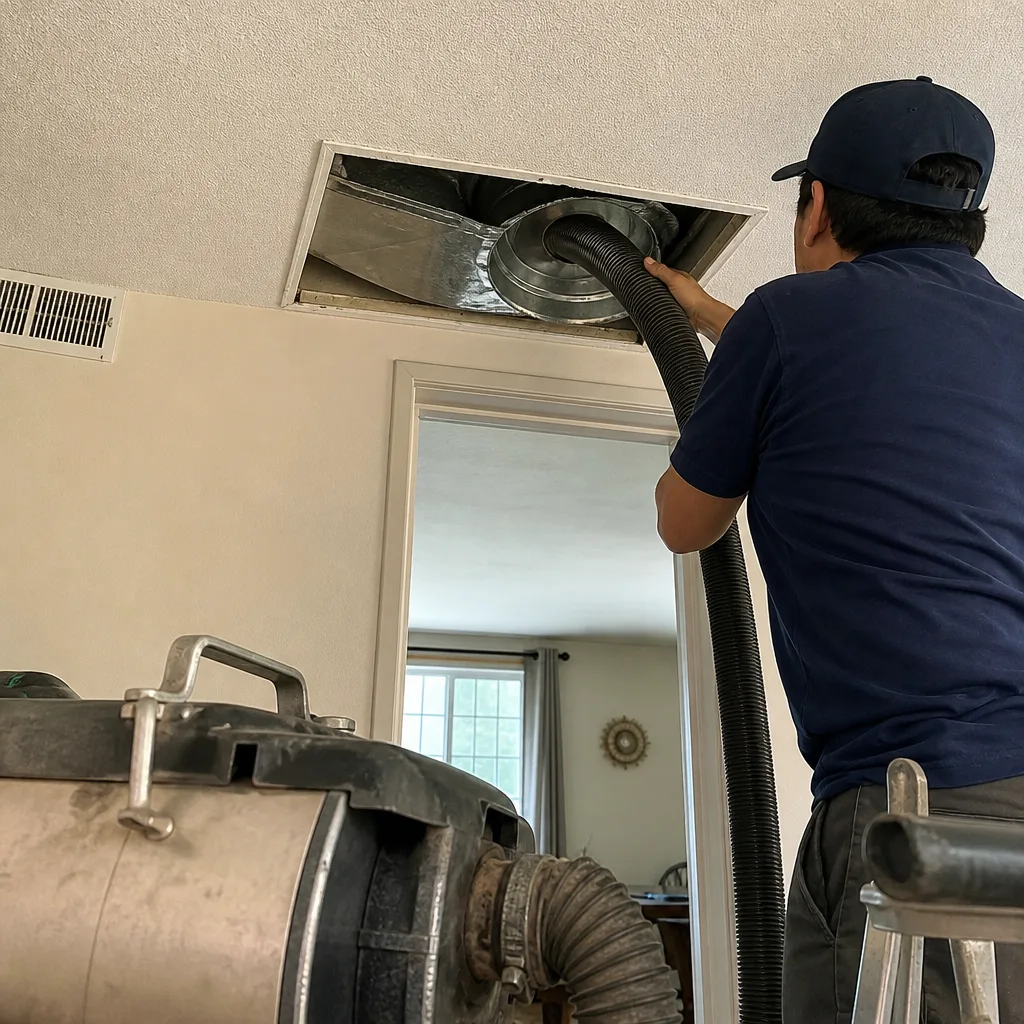
The equipment used for this matters. A portable consumer vacuum attached to a rotating brush cannot maintain negative pressure across an entire duct run. Professional systems like the Rotobrush and Nikro units used by Duct Cleaning Monterey Park home professionals pull air from the entire duct network while agitating the interior surfaces, which is the only method that removes renovation dust that has been pressed into duct lining by airflow.
Emergency HVAC Shutdown Procedures for Monterey Park Homes
During a contamination event, your instinct might be to run the HVAC system to “filter the air.” In many Monterey Park scenarios, the correct action is the opposite: shut the system down completely and keep it off until the event passes and an assessment is made. Running contaminated air through your system converts a temporary outdoor event into a persistent indoor problem.
Here is a simple shutdown checklist every Monterey Park homeowner should know:
- Set the thermostat to “Off” mode, not just a higher or lower setpoint. Any temperature setpoint may still call for blower operation. “Off” means off.
- Switch the fan setting from “Auto” to “On” only after you’ve confirmed you want continuous filtration with an upgraded filter. If you have a standard filter, leave it on “Auto” or off entirely.
- Close all exterior doors and windows. During a smoke event, a single open window defeats every other action you take.
- Turn off any whole-house fan or attic fan. These pull outside air directly into the living space and often into the duct system through negative pressure.
- If you have a fresh-air intake duct, close its damper. Not all Monterey Park homes have one, but many 1990s and newer builds do. It’s typically a small labeled duct near the air handler.
After the event has passed, do not immediately blast the system to “clear things out.” Running the blower at full speed across dust-laden duct interiors is how particles that settled during the event become airborne again. Instead, inspect the filter first. If it’s visibly loaded, replace it. Then run the system on “Fan On” with a fresh high-MERV filter installed, and plan for a full duct inspection and cleaning if the filter showed smoke, soot, or construction dust.
Building a Post-Emergency Service Record
After any emergency-driven duct cleaning or repair, the documentation you keep matters more than the service itself. If you sell the home, file an insurance claim, or need to prove to a future buyer that the system was properly addressed, the record is what protects you. A vague receipt that says “duct cleaning” is not sufficient.
Here is what to document and request in writing from any contractor after emergency work in your Monterey Park home:
- Pre-service photos: Request camera scope images or video of the duct interiors before cleaning begins. This establishes the condition that prompted the work.
- Post-service photos: Same angles, same duct runs, after the work. A competent contractor should provide these without being asked twice.
- Equipment used: The brand and type of cleaning system, not just “truck-mounted vacuum.” Professional systems like Nikro or Rotobrush units have specific model names. If the contractor won’t name the equipment, ask why.
- Scope of service: Which duct runs were cleaned. Supply and return. Main trunk lines and branch runs. The register count. If it says “all accessible ducts,” ask for clarification on what was not accessible and why.
- Repairs performed: If a displaced joint was found and re-sealed, if a section of flex duct was replaced, if a crushed return was rebuilt, that needs to be itemized. This is the difference between “we cleaned your ducts” and “we fixed a structural problem in your duct system.”
- Filter change recommendation: What MERV rating, what size, and when to replace.
- Running the HVAC system during active smoke at any AQI above 150. Every hour the blower runs during heavy smoke pulls more particulate into the return side and distributes it through the supply runs. When the smoke clears, the system is now a particulate reservoir.
- Assuming a filter upgrade solves post-smoke contamination. A MERV 13 filter catches particles moving through the filter. It does nothing for particles already deposited upstream. The filter is a gate, not a broom.
- Scheduling duct cleaning before renovation work is fully complete. Many Monterey Park homeowners try to time the cleaning for the last day of construction. The finish crew almost always generates more dust after the cleaning crew leaves.
- Using a coupon duct cleaning service after a contamination event. A $49 whole-house special is not equipped for post-wildfire or post-renovation particulate. The low price often reflects the tool quality, which in these scenarios means the work is cosmetic.
- Ignoring dryer vents after a smoke event. Lint already inside a dryer vent absorbs smoke odor and particulate. When the dryer runs, that contaminated lint is heated and re-circulates trace contaminants into the laundry area. Dryer Vent Cleaning in Monterey Park addresses this directly.
- Not documenting the before and after. If you need to file an insurance claim for smoke damage or demonstrate to a buyer that the system was properly addressed, a vague receipt doesn’t prove anything. Photos with timestamps do.
- Skipping the post-event inspection because “the air smells fine now.” PM2.5 and renovation dust don’t always have a detectable odor. They settle, then re-suspend when the system cycles. The absence of smell is not the absence of particulate.
Store this record with your home’s other mechanical system documents, the same folder where you keep water heater installation dates and roof replacement paperwork. In Monterey Park, where homes commonly change hands between first-generation owners and new buyers, a documented post-emergency duct service is a selling point, not a footnote.
Why Equipment Standards Matter After an Emergency
The difference between a post-emergency duct cleaning that works and one that just moves dust around is the equipment on the truck. This is not snobbery. It’s physics. Consumer-grade vacuums and small portable units cannot generate the negative pressure required to pull fine particulate from a 40-foot duct run buried in a wall cavity. They pull air from the first few feet of duct and leave the rest undisturbed.
Professional duct cleaning systems like those from Rotobrush and Nikro are designed for exactly the contamination scenarios Monterey Park homeowners face after wildfire smoke or renovation work. These systems combine high-CFM negative pressure with motorized agitation brushes that physically dislodge particulate from duct surfaces. The particulate is then pulled through the vacuum system and captured in HEPA filtration, not blown into the living room. Abatement Technologies equipment, which is used in remediation and restoration settings, reflects an additional level of air quality competency beyond standard dust removal: it’s the same category of equipment used when air quality itself is the problem, not just dust accumulation.
For ongoing air quality after an emergency event, homeowners in Monterey Park often ask us about filtration upgrades. Brands like Honeywell and Aprilaire are names that already have trust equity: Honeywell for electronic air cleaners and media filters, Aprilaire for whole-home filtration systems that integrate with existing ductwork. These are not emergency fixes. They’re the post-cleaning layer that helps prevent the next event from settling as deeply into the system. We recommend them as part of a complete post-emergency plan, not as a substitute for addressing what’s already on the duct walls. Air quality you can measure, not just feel.
Common Mistakes to Avoid
When to Call a Professional
If your filter shows visible gray, brown, or construction dust discoloration after a wildfire event, that’s the threshold. If a tremor above magnitude 4.0 occurred and you’ve noticed reduced airflow from any single register, that’s the threshold. If renovation work happened in your home and drywall dust or insulation fibers are visible around return registers, that’s the threshold. In each case, the work required is not a filter swap. It’s a full inspection with a camera scope, followed by professional cleaning with negative-pressure equipment, and potentially structural repair if the ducts themselves were compromised. Duct Cleaning Monterey Park offers free estimates in Monterey Park. Call (866) 413-8552 and describe the event. You’ll get a straight answer about whether cleaning, repair, or both are needed, with no pressure and no per-vent pricing games.
Frequently Asked Questions
Wait until the regional AQI has been below 50 for at least 48 hours and no additional smoke events are forecast. Cleaning while outdoor smoke is still present means the system pulls contaminated air back in as fast as it’s cleaned. For Monterey Park homeowners, this typically means waiting 3 to 7 days after the visible smoke clears, depending on wind patterns through the San Gabriel Valley.
Whole-system duct cleaning in Monterey Park after a contamination event typically ranges from $450 to $900 depending on home size, number of registers, and the severity of the deposits. Homes with multiple returns, two-story duct runs, or post-renovation drywall dust tend toward the higher end. A legitimate contractor quotes one flat price per system, not per vent. Call (866) 413-8552 for an exact quote after describing your situation. Estimates are free.
No. The duct interiors in most Monterey Park homes are long, narrow, and partially inaccessible from any single register. Consumer vacuums and rented equipment cannot generate the negative pressure required to pull fine particulate from deep inside supply and return runs. Worse, an unsealed access point or a poorly connected vacuum can blow contamination into the living space rather than capturing it. Professional systems like Rotobrush and Nikro units are built for this exact scenario. If the damage involves disconnected or crushed sections, that’s an air duct repair problem requiring a contractor, not a DIY project.
Cleaning removes deposited particulate from the interior surfaces of intact ductwork. Repair addresses structural problems: a joint that separated, a flex duct that collapsed, a boot that pulled away from the register, a crushed return plenum. In Monterey Park, seismic events above magnitude 4.0 can cause duct displacement even when the house shows no visible damage. Cleaning a structurally compromised duct system is wasted money because the gaps continue pulling contaminants in. The two services address different problems.
Every 3 to 5 years is the standard interval for homes without pets, smokers, recent renovation, or nearby construction. Homes with pets that shed heavily, homes within a mile of active road construction, or homes occupied by someone with respiratory sensitivity may benefit from every 2 to 3 years. After any wildfire smoke event or renovation, an inspection should be done regardless of the calendar.
If the smoke odor is coming from particulate deposited inside the duct system, professional cleaning removes the source of that odor. If the smell is in carpet, upholstery, drapes, or wall surfaces, duct cleaning alone won’t eliminate it. In our experience with Monterey Park homes after regional smoke events, duct cleaning is one component of odor removal, not a complete solution for every surface in the home.
The Bottom Line
Monterey Park homes face three specific emergency scenarios that affect duct systems: wildfire smoke that deposits fine particulate into return and supply runs, seismic events that can dislocate duct connections, and renovation work that fills the system with drywall and insulation dust. Each scenario has a defined response: seal the system during the event, inspect with a camera scope after the event, clean with professional negative-pressure equipment if contamination is confirmed, and repair structural damage rather than cleaning over it. One call for the full system. Document everything. For more guides & resources, visit our blog. If you’re uncertain, call (866) 413-8552 and ask for a straight answer. A free estimate costs less than guessing wrong.
Written by the team at Duct Cleaning Monterey Park, serving Monterey Park since 2013.
See the difference
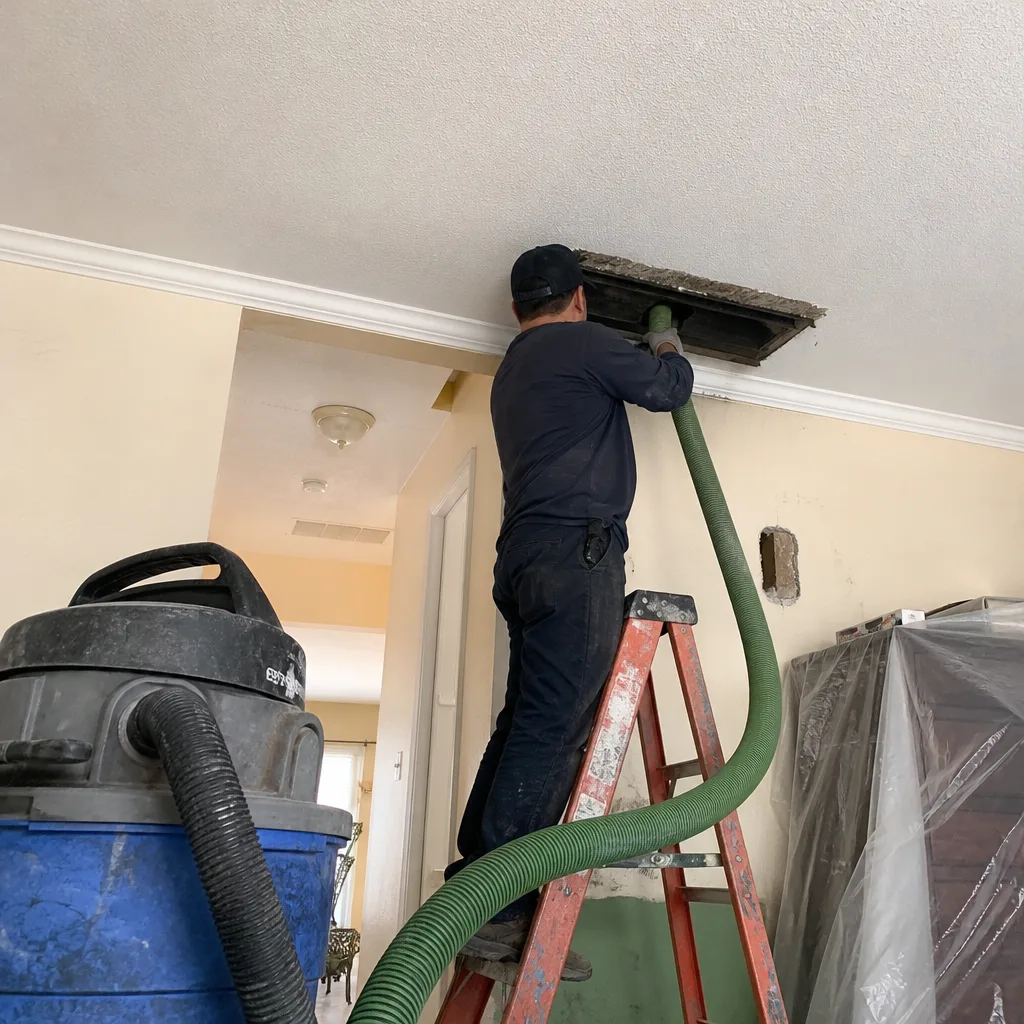 Before
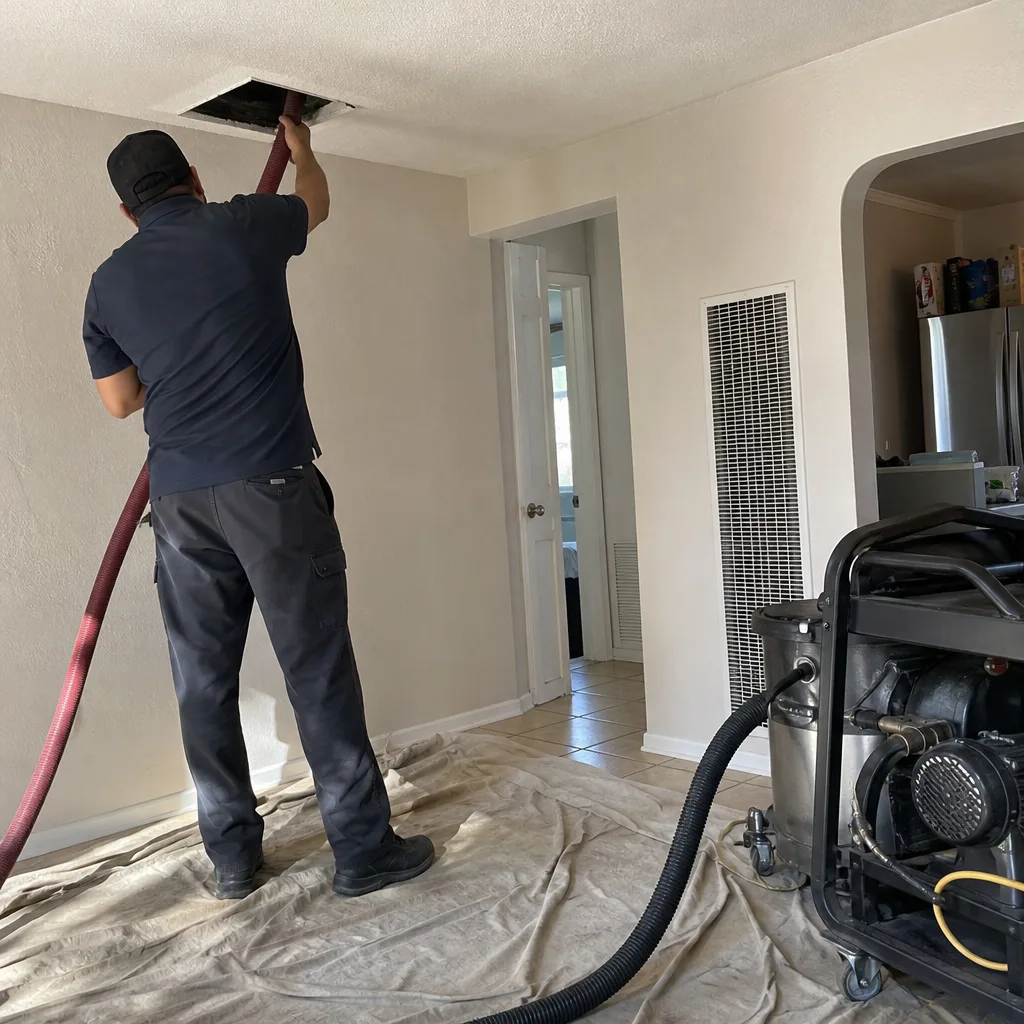 After
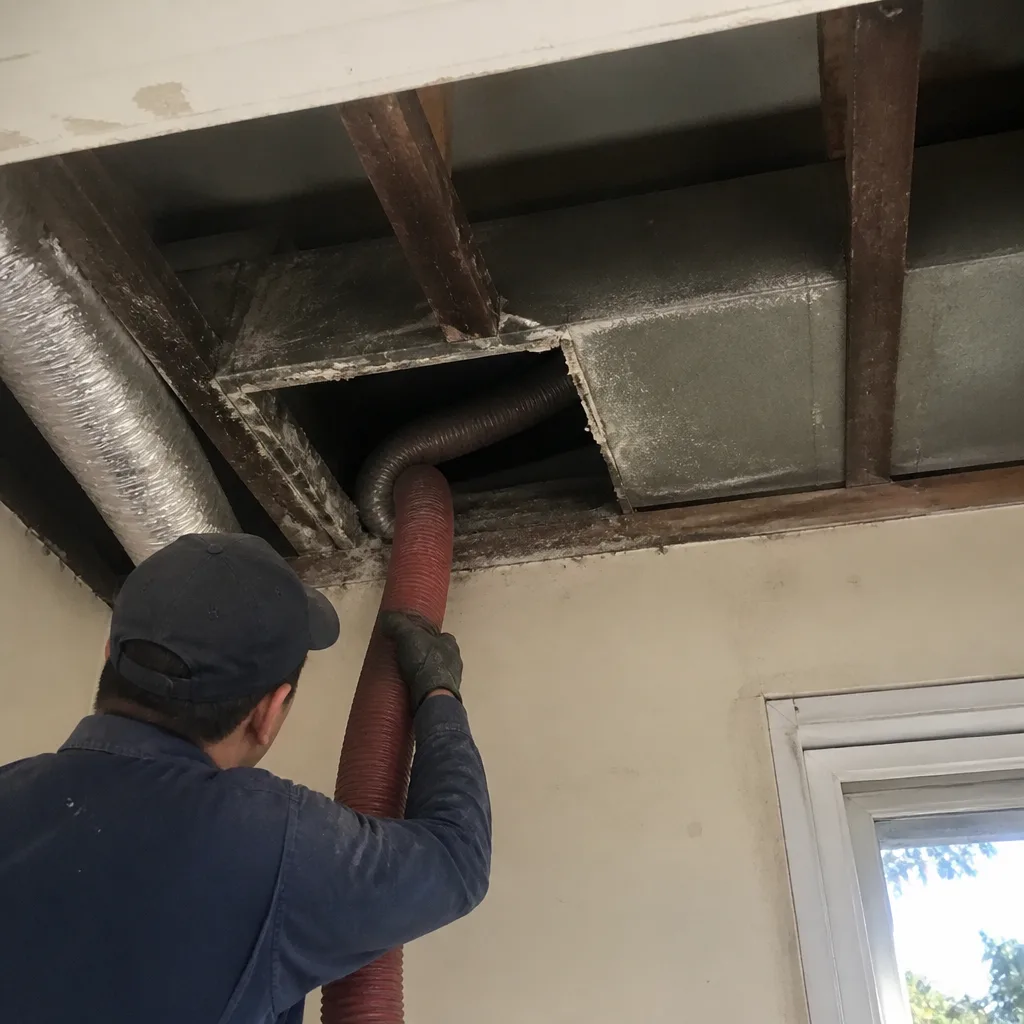 Before
 After
 Before
 After